English · Ebook
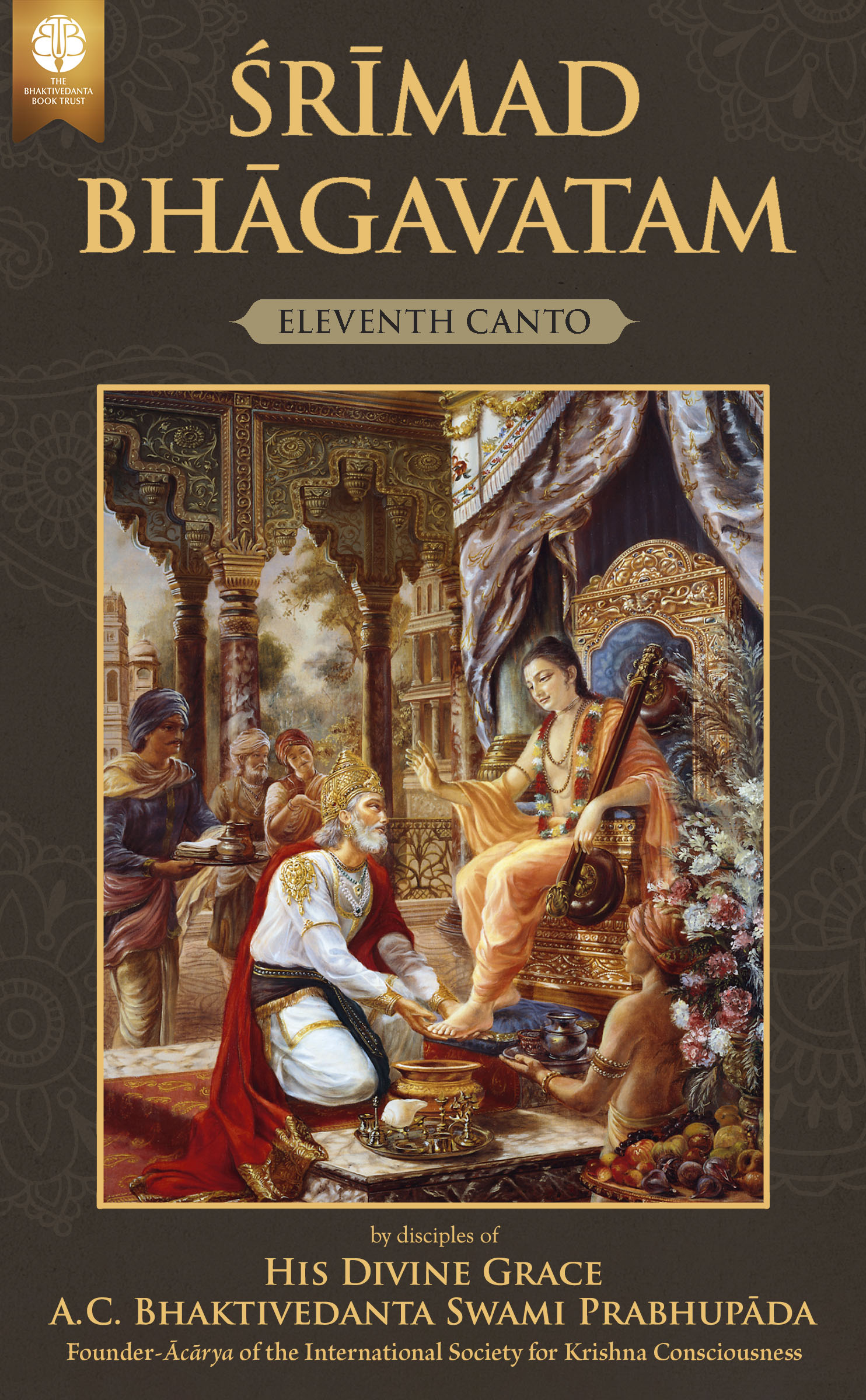
Śrīmad-Bhāgavatam, Canto Eleven
Digital purchase. Your access code will be sent by email. No physical product is shipped.
- One secure checkout
- Personal email delivery
- Support at support@krishnabookspov.com.au

English · Ebook
Digital purchase. Your access code will be sent by email. No physical product is shipped.
Know what you are choosing
Read the overview, meet the contributors and browse the contents before ordering.
After compiling the Vedas, Śrīla Vyāsadeva was inspired to present their profound essence in the form of Śrīmad-Bhāgavatam. As “the ripened fruit of the tree of Vedic literature,” the first verse of Śrīmad-Bhāgavatam makes clear that because the book is intended for people serious about spiritual progress, it will not deal with sectarian religious ideas, philosophical conjecture, or worldly concerns. The second text promises that anyone who reads the Śrīmad-Bhāgavatam systematically will achieve the spiritual success meant to be attained by all human beings.
Canto Eleven, “General History,” describes the destruction of the Yadu dynasty and Kṛṣṇa’s departure from the world. It also contains the Uddhava-gītā, the beautiful discussion between Kṛṣṇa and His devotee Uddhava. In Canto Eleven we get a “backward glance” into all the topics discussed in the first ten cantos of Śrīmad-Bhāgavatam along with a detailed analysis of bhakti and jñāna and how to give oneself to God in devotion.
This edition of Bhāgavatam is the only complete English translation with an elaborate and scholarly commentary, and it is the first edition widely available to the English-reading public. This work is the product of the scholarly and devotional effort of His Divine Grace A. C. Bhaktivedanta Swami Prabhupāda, the world's most distinguished teacher of Indian religious and philosophical thought. His Sanskrit scholarship and intimate familiarity with Vedic culture combine to reveal to the West a magnificent exposition of this important classic.

Gopīparāṇadhana Dāsa (1950-2011) was both a scholar of Sanskrit and a practitioner of devotional service to Lord Kṛṣṇa. Under the guidance of His Divine Grace A. C. Bhaktivedanta Swami Prabhupāda, he developed an expertise in Sanskrit and served for many years as an editor for the Bhaktivedanta Book Trust. When Śrīla Prabhupāda passed away, Gopīparāṇadhana served on the three-man team that completed Śrīla Prabhupāda's edition of /"Śrīmad-Bhāgavatam"/. In 1998 he and his family moved to Govardhana, the place of Śrī Kṛṣṇa's pastimes located in northern India, and an important place of pilgrimage for the followers of the Vaiṣṇava tradition. There he spent the last twelve years of his life, translating and training a new generation of devotional scholars at the Śrīmad-bhāgavata Vidyāpiṭham, a school he established for this purpose. Among his most significant literary contributions are the translations of the /"Tattva-sandabha"/, /"Bṛhad-bhāgavatāmṛta"/, and /"Kṛṣṇa Līlā Stava"/.
Hridayānanda Dāsa Goswami (Dr. Howard J. Resnick, PhD) was initiated by Śrīla Prabhupāda in 1970 and accepted vows of renunciation in 1972. After Śrīla Prabhupāda's departure from the world in 1977, Hridayānanda Dāsa Goswami was the first Westerner in history to successfully translate and comment on the canonical /"Bhāgavata Purāṇa"/ from within the tradition.
Hridayānanda Dāsa Goswami received his PhD in Sanskrit and Indian Studies from Harvard University in 1996. As a visiting scholar at UCLA, he has taught the history, philosophies, and religions of India at the Graduate Theological Union in Berkeley and, most recently, at the University of Florida in Gainesville. He has also published articles with such institutions as Harvard, Columbia, and the University of California. Having lectured at leading universities throughout the United States, Europe, India, and South America, Hridayānanda Dāsa Goswami is a much sought after speaker by colleges, universities, divinity schools, civic groups, and religious organizations of all kinds.
He has written /"A Comprehensive Guide to the Bhagavad Gita"/ and recently completed his first novel, in which a contemporary story frames an ancient tale. His current project is to present the great epic narrative of South Asia, the /"Mahābhārata"/, as a three-part historical novel.