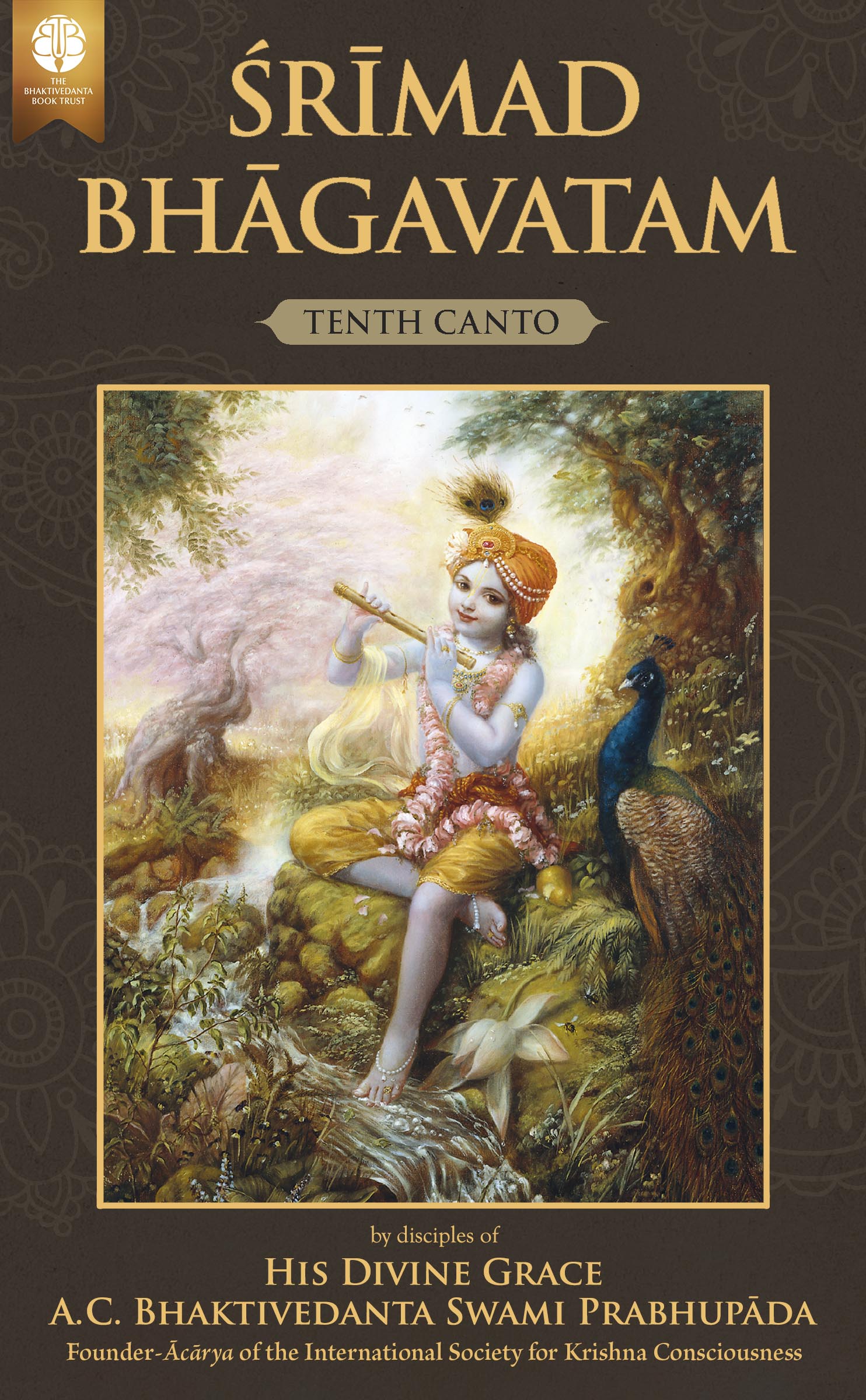
Śrīmad-Bhāgavatam, Canto Ten, Ebook, ebook cover

English · Ebook

Śrīmad-Bhāgavatam, Canto Ten

EnglishEbook
$8.18AUD

Digital purchase. Your access code will be sent by email. No physical product is shipped.

Price$8.18AUD
Checking your cart…
  • One secure checkout
  • Personal email delivery
  • Support at support@krishnabookspov.com.au
Know someone who would enjoy this?

Know what you are choosing

Explore this title

Read the overview, meet the contributors and browse the contents before ordering.

About this bookA clear overview of the title

After compiling the Vedas, Śrīla Vyāsadeva was inspired to present their profound essence in the form of Śrīmad-Bhāgavatam. As “the ripened fruit of the tree of Vedic literature,” the first verse of Śrīmad-Bhāgavatam makes clear that because the book is intended for people serious about spiritual progress, it will not deal with sectarian religious ideas, philosophical conjecture, or worldly concerns. The second text promises that anyone who reads the Śrīmad-Bhāgavatam systematically will achieve the spiritual success meant to be attained by all human beings.

Canto Ten, “The Summum Bonum,” is dedicated to Kṛṣṇa and His unlimited loving pastimes with His devotees.

This edition of Bhāgavatam is the only complete English translation with an elaborate and scholarly commentary, and it is the first edition widely available to the English-reading public. This work is the product of the scholarly and devotional effort of His Divine Grace A. C. Bhaktivedanta Swami Prabhupāda, the world's most distinguished teacher of Indian religious and philosophical thought. His Sanskrit scholarship and intimate familiarity with Vedic culture combine to reveal to the West a magnificent exposition of this important classic.

Authors and narratorsAuthor, narrator and translator details

Author information

A. C. Bhaktivedanta Swami Prabhupāda

His Divine Grace A. C. Bhaktivedanta Swami Prabhupāda appeared in this world in 1896 in Calcutta, India. He first met his spiritual master, Śrīla Bhaktisiddhānta Sarasvatī Gosvāmī, in Calcutta in 1922. Bhaktisiddhānta Sarasvatī, a prominent religious scholar and the founder of sixty-four Gauḍīya Maṭhas (Vedic institutes), liked this educated young man and convinced him to de dicate his life to teaching Vedic knowledge. Śrīla Prabhupāda became his student and, in 1933, his formally initiated disciple.

At their first meeting, in 1922, Śrīla Bhaktisiddhānta Sarasvatī requested Śrīla Prabhupāda to broadcast Vedic knowledge in English. In the years that followed, Śrīla Prabhupāda wrote a commentary on the /"Bhagavad-gītā"/, assisted the Gauḍīya Maṭha in its work and, in 1944, started /"Back to Godhead"/, an English fortnightly magazine. Singlehandedly, Śrīla Prabhupāda edited it, typed the manuscripts, checked the galley proofs, and even distributed the individual copies. The magazine is now being continued by his disciples.

In 1950 Śrīla Prabhupāda retired from married life, adopting the /vānaprastha/ (retired) order to devote more time to his studies and writing. He traveled to the holy city of Vṛndāvana, where he lived in humble circumstances in the historic temple of Rādhā-Dāmodara. There he engaged for several years in deep study and writing. He accepted the renounced order of life (/sannyāsa/) in 1959. At Rādhā-Dāmodara, Śrīla Prabhupāda began work on his life's masterpiece: a multivolume commentated translation of the eighteen-thousand-verse /"Śrīmad-Bhāgavatam"/ (/"Bhāgavata Purāṇa"/). He also wrote /"Easy Journey to Other Planets"/.

After publishing three volumes of the /"Bhāgavatam"/, Śrīla Prabhupāda came to the United States, in September 1965, to fulfill the mission of his spiritual master. Subsequently, His Divine Grace wrote more than fifty volumes of authoritative commentated translations and summary studies of the philosophical and religious classics of India.

When he first arrived by freighter in New York City, Śrīla Prabhupāda was practically penniless. Only after almost a year of great difficulty did he establish the International Society for Krishna Consciousness, in July of 1966. Before he passed away on November 14, 1977, he had guided the Society and seen it grow to a worldwide confederation of more than one hundred /āśramas/, schools, temples, institutes, and farm communities. New centers continue to open worldwide.

In 1972 His Divine Grace introduced the Vedic system of primary and secondary education in the West by founding the /gurukula/ school in Dallas, Texas. Since then his disciples have established similar schools throughout the United States and the rest of the world.

Śrīla Prabhupāda also inspired the construction of several large international cultural centers in India. At Śrīdhāma Māyāpur, in West Bengal, devotees are building a spiritual city centered on a magnificent temple - an ambitious project for which construction will extend over many years to come. In Vṛndāvana are the Krishna-Balaram Temple and International Guesthouse, /gurukula/ school, and Śrīla Prabhupāda Memorial and Museum. There are also major temples and cultural centers in Mumbai, New Delhi, Ahmedabad, Siliguri, and Ujjain. Other centers are planned in many important locations on the Indian subcontinent and around the world.

Śrīla Prabhupāda's most significant contribution, however, is his books. Highly respected by scholars for their authority, depth, and clarity, they are used as textbooks in numerous college courses. His writings have been translated into over eighty languages. The Bhaktivedanta Book Trust, established in 1972 to publish the works of His Divine Grace, has thus become the world's largest publisher of books in the field of Indian religion and philosophy.

In just twelve years, despite his advanced age, Śrīla Prabhupāda circled the globe fourteen times on lecture tours that took him to six continents. In spite of such a vigorous schedule, Śrīla Prabhupāda continued to write prolifically. His writings constitute a veritable library of Vedic philosophy, religion, literature, and culture.

Gopīparāṇadhana Dāsa

Gopīparāṇadhana Dāsa (1950-2011) was both a scholar of Sanskrit and a practitioner of devotional service to Lord Kṛṣṇa. Under the guidance of His Divine Grace A. C. Bhaktivedanta Swami Prabhupāda, he developed an expertise in Sanskrit and served for many years as an editor for the Bhaktivedanta Book Trust. When Śrīla Prabhupāda passed away, Gopīparāṇadhana served on the three-man team that completed Śrīla Prabhupāda's edition of /"Śrīmad-Bhāgavatam"/. In 1998 he and his family moved to Govardhana, the place of Śrī Kṛṣṇa's pastimes located in northern India, and an important place of pilgrimage for the followers of the Vaiṣṇava tradition. There he spent the last twelve years of his life, translating and training a new generation of devotional scholars at the Śrīmad-bhāgavata Vidyāpiṭham, a school he established for this purpose. Among his most significant literary contributions are the translations of the /"Tattva-sandabha"/, /"Bṛhad-bhāgavatāmṛta"/, and /"Kṛṣṇa Līlā Stava"/.

Hridyānanda dāsa Goswami

Hridayānanda Dāsa Goswami (Dr. Howard J. Resnick, PhD) was initiated by Śrīla Prabhupāda in 1970 and accepted vows of renunciation in 1972. After Śrīla Prabhupāda's departure from the world in 1977, Hridayānanda Dāsa Goswami was the first Westerner in history to successfully translate and comment on the canonical /"Bhāgavata Purāṇa"/ from within the tradition.

Hridayānanda Dāsa Goswami received his PhD in Sanskrit and Indian Studies from Harvard University in 1996. As a visiting scholar at UCLA, he has taught the history, philosophies, and religions of India at the Graduate Theological Union in Berkeley and, most recently, at the University of Florida in Gainesville. He has also published articles with such institutions as Harvard, Columbia, and the University of California. Having lectured at leading universities throughout the United States, Europe, India, and South America, Hridayānanda Dāsa Goswami is a much sought after speaker by colleges, universities, divinity schools, civic groups, and religious organizations of all kinds.

He has written /"A Comprehensive Guide to the Bhagavad Gita"/ and recently completed his first novel, in which a contemporary story frames an ancient tale. His current project is to present the great epic narrative of South Asia, the /"Mahābhārata"/, as a three-part historical novel.

Contents103 listed sections
  1. Cover
  2. Verse Page
  3. Title Page
  4. Books by Srila Prabhupada
  5. Copyright Information
  6. Extended Table of Contents
  7. Preface
  8. Foreword
  9. Chapter 1: The Advent of Lord Krsna: Introduction
  10. Chapter 2: Prayers by the Demigods for Lord Krsna in the Womb
  11. Chapter 3: The Birth of Lord Krsna
  12. Chapter 4: The Atrocities of King Kamsa
  13. Chapter 5: The Meeting of Nanda Maharaja and Vasudeva
  14. Chapter 6: The Killing of the Demon Putana
  15. Chapter 7: The Killing of the Demon Trnavarta
  16. Chapter 8: Lord Krsna Shows the Universal Form Within His Mouth
  17. Chapter 9: Mother Yasoda Binds Lord Krsna
  18. Chapter 10: The Deliverance of the Yamala-arjuna Trees
  19. Chapter 11: The Childhood Pastimes of Krsna
  20. Chapter 12: The Killing of the Demon Aghasura
  21. Chapter 13: The Stealing of the Boys and Calves by Brahma
  22. Chapter 14: Brahma’s Prayers to Lord Krsna
  23. Chapter 15: The Killing of Dhenuka, the Ass Demon
  24. Chapter 16: Krsna Chastises the Serpent Kaliya
  25. Chapter 17: The History of Kaliya
  26. Chapter 18: Lord Balarama Slays the Demon Pralamba
  27. Chapter 19: Swallowing the Forest Fire
  28. Chapter 20: The Rainy Season and Autumn in Vrndavana
  29. Chapter 21: The Gopis Glorify the Song of Krsna’s Flute
  30. Chapter 22: Krsna Steals the Garments of the Unmarried Gopis
  31. Chapter 23: The Brahmanas’ Wives Blessed
  32. Chapter 24: Worshiping Govardhana Hill
  33. Chapter 25: Lord Krsna Lifts Govardhana Hill
  34. Chapter 26: Wonderful Krsna
  35. Chapter 27: Lord Indra and Mother Surabhi Offer Prayers
  36. Chapter 28: Krsna Rescues Nanda Maharaja from the Abode of Varuna
  37. Chapter 29: Krsna and the Gopis Meet for the Rasa Dance
  38. Chapter 30: The Gopis Search for Krsna
  39. Chapter 31: The Gopis’ Songs of Separation
  40. Chapter 32: The Reunion
  41. Chapter 33: The Rasa Dance
  42. Chapter 34: Nanda Maharaja Saved and Saṅkhacuda Slain
  43. Chapter 35: The Gopis Sing of Krsna as He Wanders in the Forest
  44. Chapter 36: The Slaying of Arista, the Bull Demon
  45. Chapter 37: The Killing of the Demons Kesi and Vyoma
  46. Chapter 38: Akrura’s Arrival in Vrndavana
  47. Chapter 39: Akrura’s Vision
  48. Chapter 40: The Prayers of Akrura
  49. Chapter 41: Krsna and Balarama Enter Mathura
  50. Chapter 42: The Breaking of the Sacrificial Bow
  51. Chapter 43: Krsna Kills the Elephant Kuvalayapida
  52. Chapter 44: The Killing of Kamsa
  53. Chapter 45: Krsna Rescues His Teacher’s Son
  54. Chapter 46: Uddhava Visits Vrndavana
  55. Chapter 47: The Song of the Bee
  56. Chapter 48: Krsna Pleases His Devotees
  57. Chapter 49: Akrura’s Mission in Hastinapura
  58. Chapter 50: Krsna Establishes the City of Dvaraka
  59. Chapter 51: The Deliverance of Mucukunda
  60. Chapter 52: Rukmini’s Message to Lord Krsna
  61. Chapter 53: Krsna Kidnaps Rukmini
  62. Chapter 54: The Marriage of Krsna and Rukmini
  63. Chapter 55: The History of Pradyumna
  64. Chapter 56: The Syamantaka Jewel
  65. Chapter 57: Satrajit Murdered, the Jewel Returned
  66. Chapter 58: Krsna Marries Five Princesses
  67. Chapter 59: The Killing of the Demon Naraka
  68. Chapter 60: Lord Krsna Teases Queen Rukmini.
  69. Chapter 61: Lord Balarama Slays Rukmi
  70. Chapter 62: The Meeting of Usa and Aniruddha
  71. Chapter 63: Lord Krsna Fights with Banasura
  72. Chapter 64: The Deliverance of King Nrga
  73. Chapter 65: Lord Balarama Visits Vrndavana
  74. Chapter 66: Paundraka, the False Vasudeva
  75. Chapter 67: Lord Balarama Slays Dvivida Gorilla
  76. Chapter 68: The Marriage of Samba
  77. Chapter 69: Narada Muni Visits Lord Krsna’s Palaces in Dvaraka
  78. Chapter 70: Lord Krsna’s Daily Activities
  79. Chapter 71: The Lord Travels to Indraprastha
  80. Chapter 72: The Slaying of the Demon Jarasandha
  81. Chapter 73: Lord Krsna Blesses the Liberated Kings
  82. Chapter 74: The Deliverance of Sisupala at the Rajasuya Sacrifice
  83. Chapter 75: Duryodhana Humiliated
  84. Chapter 76: The Battle Between Salva and the Vrsnis
  85. Chapter 77: Lord Krsna Slays the Demon Salva
  86. Chapter 78: The Killing of Dantavakra, Viduratha and Romaharsana
  87. Chapter 79: Lord Balarama Goes on Pilgrimage
  88. Chapter 80: The Brahmana Sudama Visits Lord Krsna in Dvaraka
  89. Chapter 81: The Lord Blesses Sudama Brahmana
  90. Chapter 82: Krsna and Balarama Meet the Inhabitants of Vrndavana
  91. Chapter 83: Draupadi Meets the Queens of Krsna
  92. Chapter 84: The Sages’ Teachings at Kuruksetra
  93. Chapter 85: Lord Krsna Instructs Vasudeva and Retrieves Devaki’s Sons
  94. Chapter 86: Arjuna Kidnaps Subhadra, and Krsna Blesses His Devotees
  95. Chapter 87: The Prayers of the Personified Vedas
  96. Chapter 88: Lord Siva Saved from Vrkasura
  97. Chapter 89: Krsna and Arjuna Retrieve a Brahmana’s Sons
  98. Chapter 90: Summary of Lord Krsna’s Glories
  99. Appendixes
  100. The Author
  101. References
  102. Glossary
  103. Sanskrit Pronunciation Guide

More ways to explore

Where to start with Krishna conscious books