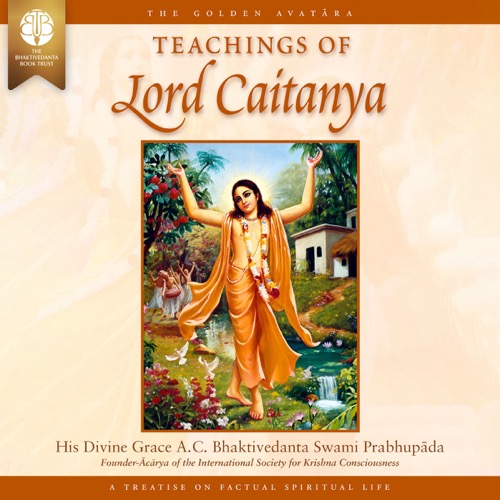
Author information
A. C. Bhaktivedanta Swami Prabhupāda
His Divine Grace A. C. Bhaktivedanta Swami Prabhupāda appeared in this world in 1896 in Calcutta, India. He first met his spiritual master, Śrīla Bhaktisiddhānta Sarasvatī Gosvāmī, in Calcutta in 1922. Bhaktisiddhānta Sarasvatī, a prominent religious scholar and the founder of sixty-four Gauḍīya Maṭhas (Vedic institutes), liked this educated young man and convinced him to de dicate his life to teaching Vedic knowledge. Śrīla Prabhupāda became his student and, in 1933, his formally initiated disciple.
At their first meeting, in 1922, Śrīla Bhaktisiddhānta Sarasvatī requested Śrīla Prabhupāda to broadcast Vedic knowledge in English. In the years that followed, Śrīla Prabhupāda wrote a commentary on the /"Bhagavad-gītā"/, assisted the Gauḍīya Maṭha in its work and, in 1944, started /"Back to Godhead"/, an English fortnightly magazine. Singlehandedly, Śrīla Prabhupāda edited it, typed the manuscripts, checked the galley proofs, and even distributed the individual copies. The magazine is now being continued by his disciples.
In 1950 Śrīla Prabhupāda retired from married life, adopting the /vānaprastha/ (retired) order to devote more time to his studies and writing. He traveled to the holy city of Vṛndāvana, where he lived in humble circumstances in the historic temple of Rādhā-Dāmodara. There he engaged for several years in deep study and writing. He accepted the renounced order of life (/sannyāsa/) in 1959. At Rādhā-Dāmodara, Śrīla Prabhupāda began work on his life's masterpiece: a multivolume commentated translation of the eighteen-thousand-verse /"Śrīmad-Bhāgavatam"/ (/"Bhāgavata Purāṇa"/). He also wrote /"Easy Journey to Other Planets"/.
After publishing three volumes of the /"Bhāgavatam"/, Śrīla Prabhupāda came to the United States, in September 1965, to fulfill the mission of his spiritual master. Subsequently, His Divine Grace wrote more than fifty volumes of authoritative commentated translations and summary studies of the philosophical and religious classics of India.
When he first arrived by freighter in New York City, Śrīla Prabhupāda was practically penniless. Only after almost a year of great difficulty did he establish the International Society for Krishna Consciousness, in July of 1966. Before he passed away on November 14, 1977, he had guided the Society and seen it grow to a worldwide confederation of more than one hundred /āśramas/, schools, temples, institutes, and farm communities. New centers continue to open worldwide.
In 1972 His Divine Grace introduced the Vedic system of primary and secondary education in the West by founding the /gurukula/ school in Dallas, Texas. Since then his disciples have established similar schools throughout the United States and the rest of the world.
Śrīla Prabhupāda also inspired the construction of several large international cultural centers in India. At Śrīdhāma Māyāpur, in West Bengal, devotees are building a spiritual city centered on a magnificent temple - an ambitious project for which construction will extend over many years to come. In Vṛndāvana are the Krishna-Balaram Temple and International Guesthouse, /gurukula/ school, and Śrīla Prabhupāda Memorial and Museum. There are also major temples and cultural centers in Mumbai, New Delhi, Ahmedabad, Siliguri, and Ujjain. Other centers are planned in many important locations on the Indian subcontinent and around the world.
Śrīla Prabhupāda's most significant contribution, however, is his books. Highly respected by scholars for their authority, depth, and clarity, they are used as textbooks in numerous college courses. His writings have been translated into over eighty languages. The Bhaktivedanta Book Trust, established in 1972 to publish the works of His Divine Grace, has thus become the world's largest publisher of books in the field of Indian religion and philosophy.
In just twelve years, despite his advanced age, Śrīla Prabhupāda circled the globe fourteen times on lecture tours that took him to six continents. In spite of such a vigorous schedule, Śrīla Prabhupāda continued to write prolifically. His writings constitute a veritable library of Vedic philosophy, religion, literature, and culture.