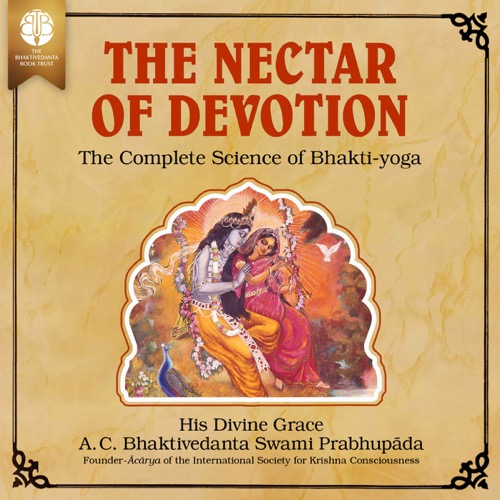
The Nectar of Devotion, Audiobook, audiobook cover

English · Audiobook

The Nectar of Devotion

EnglishAudiobook14 hours 51 minutesNarrated by Nareśvara Dāsa
$14.78AUD

Digital purchase. Your access code will be sent by email. No physical product is shipped.

Price$14.78AUD
Checking your cart…
  • One secure checkout
  • Personal email delivery
  • Support at support@krishnabookspov.com.au
Know someone who would enjoy this?

Know what you are choosing

Explore this title

Read the overview, meet the contributors and browse the contents before ordering.

About this bookA clear overview of the title

While the European Renaissance was gaining momentum in Europe, a spiritual revolution was sweeping India, breaking open the highly ritualized religion of the Sanskrit Vedas and delivering its heart through the power of sacred song (kīrtana) to anyone who would take it. This revolution was led by the ecstatic mystic Śrī Kṛṣṇa Caitanya, whose renowned disciple, Śrīla Rūpa Gosvāmī, wrote the fifteenth-century masterpiece, the Bhakti-rasāmṛta-sindhu

The Nectar of Devotion is A. C. Bhaktivedanta Swami Prabhupāda's summary study of that great work.

We cannot be happy without satisfying our fundamental desire to love – a hankering rooted in the soul's natural love for the reservoir of all love, the Supreme. Come and explore the intricacies of that deepest love in this devotional classic.

Authors and narratorsAuthor, narrator and translator details

Author information

A. C. Bhaktivedanta Swami Prabhupāda

His Divine Grace A. C. Bhaktivedanta Swami Prabhupāda appeared in this world in 1896 in Calcutta, India. He first met his spiritual master, Śrīla Bhaktisiddhānta Sarasvatī Gosvāmī, in Calcutta in 1922. Bhaktisiddhānta Sarasvatī, a prominent religious scholar and the founder of sixty-four Gauḍīya Maṭhas (Vedic institutes), liked this educated young man and convinced him to de dicate his life to teaching Vedic knowledge. Śrīla Prabhupāda became his student and, in 1933, his formally initiated disciple.

At their first meeting, in 1922, Śrīla Bhaktisiddhānta Sarasvatī requested Śrīla Prabhupāda to broadcast Vedic knowledge in English. In the years that followed, Śrīla Prabhupāda wrote a commentary on the /"Bhagavad-gītā"/, assisted the Gauḍīya Maṭha in its work and, in 1944, started /"Back to Godhead"/, an English fortnightly magazine. Singlehandedly, Śrīla Prabhupāda edited it, typed the manuscripts, checked the galley proofs, and even distributed the individual copies. The magazine is now being continued by his disciples.

In 1950 Śrīla Prabhupāda retired from married life, adopting the /vānaprastha/ (retired) order to devote more time to his studies and writing. He traveled to the holy city of Vṛndāvana, where he lived in humble circumstances in the historic temple of Rādhā-Dāmodara. There he engaged for several years in deep study and writing. He accepted the renounced order of life (/sannyāsa/) in 1959. At Rādhā-Dāmodara, Śrīla Prabhupāda began work on his life's masterpiece: a multivolume commentated translation of the eighteen-thousand-verse /"Śrīmad-Bhāgavatam"/ (/"Bhāgavata Purāṇa"/). He also wrote /"Easy Journey to Other Planets"/.

After publishing three volumes of the /"Bhāgavatam"/, Śrīla Prabhupāda came to the United States, in September 1965, to fulfill the mission of his spiritual master. Subsequently, His Divine Grace wrote more than fifty volumes of authoritative commentated translations and summary studies of the philosophical and religious classics of India.

When he first arrived by freighter in New York City, Śrīla Prabhupāda was practically penniless. Only after almost a year of great difficulty did he establish the International Society for Krishna Consciousness, in July of 1966. Before he passed away on November 14, 1977, he had guided the Society and seen it grow to a worldwide confederation of more than one hundred /āśramas/, schools, temples, institutes, and farm communities. New centers continue to open worldwide.

In 1972 His Divine Grace introduced the Vedic system of primary and secondary education in the West by founding the /gurukula/ school in Dallas, Texas. Since then his disciples have established similar schools throughout the United States and the rest of the world.

Śrīla Prabhupāda also inspired the construction of several large international cultural centers in India. At Śrīdhāma Māyāpur, in West Bengal, devotees are building a spiritual city centered on a magnificent temple - an ambitious project for which construction will extend over many years to come. In Vṛndāvana are the Krishna-Balaram Temple and International Guesthouse, /gurukula/ school, and Śrīla Prabhupāda Memorial and Museum. There are also major temples and cultural centers in Mumbai, New Delhi, Ahmedabad, Siliguri, and Ujjain. Other centers are planned in many important locations on the Indian subcontinent and around the world.

Śrīla Prabhupāda's most significant contribution, however, is his books. Highly respected by scholars for their authority, depth, and clarity, they are used as textbooks in numerous college courses. His writings have been translated into over eighty languages. The Bhaktivedanta Book Trust, established in 1972 to publish the works of His Divine Grace, has thus become the world's largest publisher of books in the field of Indian religion and philosophy.

In just twelve years, despite his advanced age, Śrīla Prabhupāda circled the globe fourteen times on lecture tours that took him to six continents. In spite of such a vigorous schedule, Śrīla Prabhupāda continued to write prolifically. His writings constitute a veritable library of Vedic philosophy, religion, literature, and culture.

Narrator

Nareśvara Dāsa

Nareśvara Dāsa joined ISKCON in 1976 in Mexico City and was initiated by Śrīla Prabhupāda in 1977. He has served in New York, Kolkata, Australia, and Māyāpur, where he has had a variety of mostly managerial services, including as co-director of ISKCON Māyāpur and member of the Śrī Māyāpur Project Development Committee.

He has been managing the Western Pacific BBT since 1983, which currently covers Australia and New Zealand. Nareśvara Dāsa is one of the original directors of The Bhaktivedanta Book Trust International. He is now focusing his energy on narrating Śrīla Prabhupāda’s works for listeners worldwide.

Contents57 listed sections
  1. Opening Credits
  2. Dedication
  3. Preface
  4. Introduction
  5. Chapter 1: Characteristics of Pure Devotional Service
  6. Chapter 2: The First Stages of Devotion
  7. Chapter 3: Eligibility of the Candidate for Accepting Devotional Service
  8. Chapter 4: Devotional Service Surpasses All Liberation
  9. Chapter 5: The Purity of Devotional Service
  10. Chapter 6: How to Discharge Devotional Service
  11. Chapter 7: Evidence Regarding Devotional Principles
  12. Chapter 8: Offenses to Be Avoided
  13. Chapter 9: Further Consideration of Devotional Principles
  14. Chapter 10: Techniques of Hearing and Remembering
  15. Chapter 11: Aspects of Transcendental Service
  16. Chapter 12: Further Aspects of Transcendental Service
  17. Chapter 13: Five Potent Forms of Devotional Service
  18. Chapter 14: Devotional Qualifications
  19. Chapter 15: Spontaneous Devotional Service
  20. Chapter 16: Spontaneous Devotion Further Described
  21. Chapter 17: Ecstatic Love
  22. Chapter 18: Character of One in Ecstatic Love
  23. Chapter 19: Devotional Service in Pure Love of God
  24. Chapter 20: Transcendental Mellow
  25. Chapter 21: Qualities of Śrī Kṛṣṇa
  26. Chapter 22: Qualities of Śrī Kṛṣṇa Further Explained
  27. Chapter 23: Kṛṣṇa’s Personality
  28. Chapter 24: Further Traits of Śrī Kṛṣṇa
  29. Chapter 25: Devotees of Kṛṣṇa
  30. Chapter 26: Stimulation for Ecstatic Love
  31. Chapter 27: Symptoms of Ecstatic Love
  32. Chapter 28: Existential Ecstatic Love
  33. Chapter 29: Expressions of Love for Kṛṣṇa
  34. Chapter 30: Further Features of Ecstatic Love for Kṛṣṇa
  35. Chapter 31: Additional Symptoms
  36. Chapter 32: Symptoms of Continuous Ecstasy
  37. Chapter 33: Indirect Expressions of Ecstatic Love
  38. Chapter 34: The Nectar of Devotion
  39. Chapter 35: Neutral Love of God
  40. Chapter 36: Transcendental Affection (Servitude)
  41. Chapter 37: Impetuses for Kṛṣṇa’s Service
  42. Chapter 38: Indifference and Separation
  43. Chapter 39: Ways of Meeting Kṛṣṇa
  44. Chapter 40: Reverential Devotion of Sons and Other Subordinates
  45. Chapter 41: Fraternal Devotion
  46. Chapter 42: Fraternal Loving Affairs
  47. Chapter 43: Parenthood
  48. Chapter 44: Devotional Service in Conjugal Love
  49. Chapter 45: Laughing Ecstasy
  50. Chapter 46: Astonishment and Chivalry
  51. Chapter 47: Compassion and Anger
  52. Chapter 48: Dread and Ghastliness
  53. Chapter 49: Mixing of Rasas
  54. Chapter 50: Further Analysis of Mixed Rasas
  55. Chapter 51: Perverted Expression of Mellows
  56. The Author
  57. Closing Credits

More ways to explore

Where to start with Krishna conscious books